Confirmed · Lead story
Connected cases drive national ORC results
A nine-day operation across 32 states produced more than 1,900 apprehensions and arrests. The frontline lesson is less about the headline number than the shared intelligence behind it.
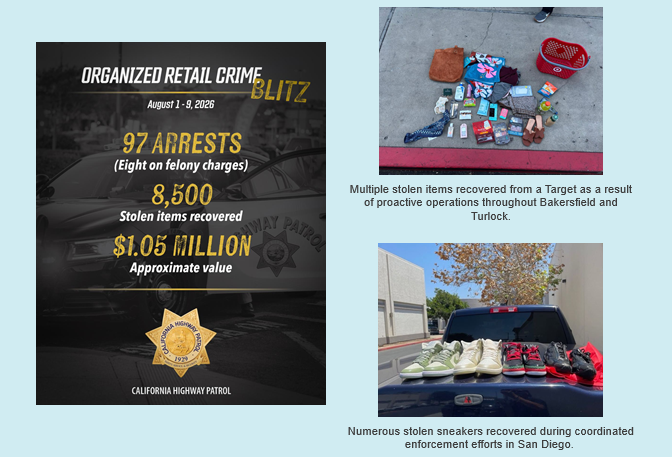
The second National Organized Retail Crime Blitz brought together 84 law-enforcement agencies and 40 retail brands between Aug. 1 and 9. Organizers also reported seven fencing-related leads, six recovered stolen vehicles, eight recovered weapons and 42 cases involving controlled substances. One apprehension reportedly led investigators to a trafficking victim who received care while the related investigation continued.
California independently documented 97 arrests and approximately $1.05 million in recovered merchandise during its portion of the operation.
Treat every solid case as a possible piece of a larger pattern. Consistent identifiers—vehicle, associates, item mix, method, transaction details, timestamps and evidence references—make lawful cross-store and cross-jurisdiction linking possible.
Verification: NRF results, Sept. 17 · California Highway Patrol, Aug. 18 · Chain Drug Review, Sept. 17
National field brief
Theft pressure is shifting, not disappearing

NRF's 2026 research reported an average 12.4% reduction in shoplifting incidents and an 8.1% reduction in merchandise-theft incidents from 2024 to 2025 among participating retailers.
At the same time, respondents reported greater pressure from repeat offenders, ORC-related shoplifting, walkout/pushout theft, phone scams, gift-card fraud, and cargo or supply-chain theft.
These survey findings do not establish universal crime rates. They indicate that visible store theft can ease while loss moves into harder-to-detect channels.
| Signal | What an investigator should preserve |
|---|---|
| Repeat offender | Cross-date identifiers, previous report numbers, vehicles, associates and repeated methods. |
| Walkout / pushout | Approach route, exit, cart or bag load, direction of travel and uninterrupted video bookmarks. |
| Gift-card / phone scam | Register, transaction ID, exact time, tender, receipt/card identifiers and employee account—without guessing intent. |
| Cargo / supply chain | Shipment ID, seal condition, custody changes, delivery window and receiving discrepancy. |
A properly documented series of smaller incidents may support a larger investigation. That can be more valuable—and considerably safer—than an unnecessarily risky intervention.
Verification: NRF full research page · NRF research release · NRF ORC policy summary. These remain industry survey findings rather than independent government crime measurements.
Technology & evidence
ALPR evidence needs governance, not blind trust

Confirmed
- Multi-factor authentication is required for all Flock users.
- A seven-day default retention period applies to new law-enforcement customers; private-sector customers retain existing account terms unless changed.
- Law-enforcement safeguards include case codes, audit assistance, atypical-activity controls and review flags for emergency searches.
- Flock says private organizations control whether their camera access is shared with authorized agencies, subject to applicable terms and law.
Developing · not fully confirmed
WIRED and 404 Media jointly reported that a group physically removed a Flock camera and extracted stored media and an encryption key. Another outlet repeated those findings but relied on the same underlying reporting. Flock's public advisory page listed no published advisory as of Sept. 15. The technical allegations therefore do not meet this publication's independent three-source standard.
If your operation uses ALPR or cloud video, confirm who can search it, how searches are logged, the retention period, how original metadata is preserved, how evidence is exported, whether tampering generates an alert, and how custody is documented.
Verification: Flock private-sector update · Flock security advisories · AP governance overview · WIRED developing report
KC Metro Watch
Bi-state coverage: Missouri and Kansas
Coverage includes Kansas City, Independence and the broader Jackson-Clay-Platte-Cass area, plus Johnson and Wyandotte counties and other connected metro jurisdictions.
No new KC-metro legal or policy development met the three-source publication threshold. Routine arrests and isolated theft reports were not promoted into a trend.
| Missouri baseline | Kansas baseline |
|---|---|
| Current law permits qualifying ORC conduct under an ongoing agreement to be aggregated across different times and jurisdictions. Missouri's Class C felony range begins at $750 and remains below $10,000; qualifying ORC involving $10,000 or more falls within the higher classification described in the statute. Property damage may count toward the calculation. | Kansas defines ORC around an organized plan involving at least $5,000 in merchandise within 12 months. Penalties increase at $25,000 and $100,000. Venue may exist in any county where at least $1 of the merchandise was taken, received, sold or purchased. |
Kansas City, Missouri reporting note. KCPD's current online system accepts qualifying business-shoplifting reports involving losses below $2,000 when its listed conditions are met. Crime in progress, injury, firearm involvement and cases outside its online criteria require a different response path. The page recommends prompt, chronological narratives and permits image uploads; its FAQ states that video cannot be uploaded through that form.
A metro case can cross city, county and state lines quickly. Record the exact store jurisdiction, date/time, loss and damage separately for every event. Preserve original evidence and approved identifiers before assuming another agency can access your system.
Missouri verification: current statute · HB 495 official record · signed-bill record
Kansas verification: current statute · session law · legislative summary
KCPD: online reporting · reporting FAQ · crime mapping
Officer's briefing
Five actions worth carrying into the week
- Build the linkable record.
Capture exact times, transaction IDs, vehicles, associates, item patterns and prior cases. - Separate observation from inference.
Identify what was observed, recorded, reported or concluded. - Preserve the original.
Retain native evidence and metadata when policy permits; document exports, bookmarks and handoffs. - Confirm sharing authority.
Verify company policy, privacy restrictions, system permissions and recipient identity before sharing case material. - Escalate the pattern.
A recurring low-dollar event or shared vehicle may be more important than one isolated high-dollar incident.
Editorial standard
Verification before publication
Consequential claims are published only when supported by three credible checks, preferably a controlling primary record plus two reliable confirmations. Multiple articles repeating the same underlying report do not count as independent verification.
When three independent confirmations do not exist, the limitation is disclosed and the item is labeled developing or analysis—or excluded. Arrests and charges remain allegations unless and until proven in court.